Calocurb pitches appetite support after GLP-1 treatment
Calocurb founder and chief executive Sarah Kennedy discussed her company’s hops-based supplement for people stopping GLP-1 medicines on a recent episode of the Live + Well podcast. The discussion, reported by the Los Angeles Times, focused on returning hunger and whether stimulating the body’s own appetite hormones could help.
The company is marketing Calocurb partly to people coming off weight-loss treatment. Its pitch addresses a difficult transition: medicines such as Wegovy can reduce hunger while they are being taken, but that effect does not necessarily persist once treatment ends.
According to the report, cost and side effects can make continued treatment difficult. After stopping, some people experience renewed preoccupation with eating — often described as food noise — as well as weight regain.
The distinction between that problem and the proposed solution is important. The Los Angeles Times account sets out Kennedy’s explanation of how the supplement is intended to work, but presents no clinical trial results showing that Calocurb prevents weight regain in people who have stopped GLP-1 medicines.
This commercial interest in the period after treatment extends beyond one supplement, a development explored in our coverage of food companies targeting people concerned about GLP-1 weight regain.
How the hops supplement differs from semaglutide
GLP-1 medicines act on pathways involved in appetite and fullness. Semaglutide, the active ingredient in Wegovy, directly activates GLP-1 receptors and has effects lasting for days. When treatment stops and its effects diminish, the appetite-suppressing benefit can fade.
There is also the body’s response to weight loss itself. The report describes how reducing calorie intake can intensify the drive to eat, leaving someone who has stopped medication facing both the loss of its effect and stronger hunger signals.
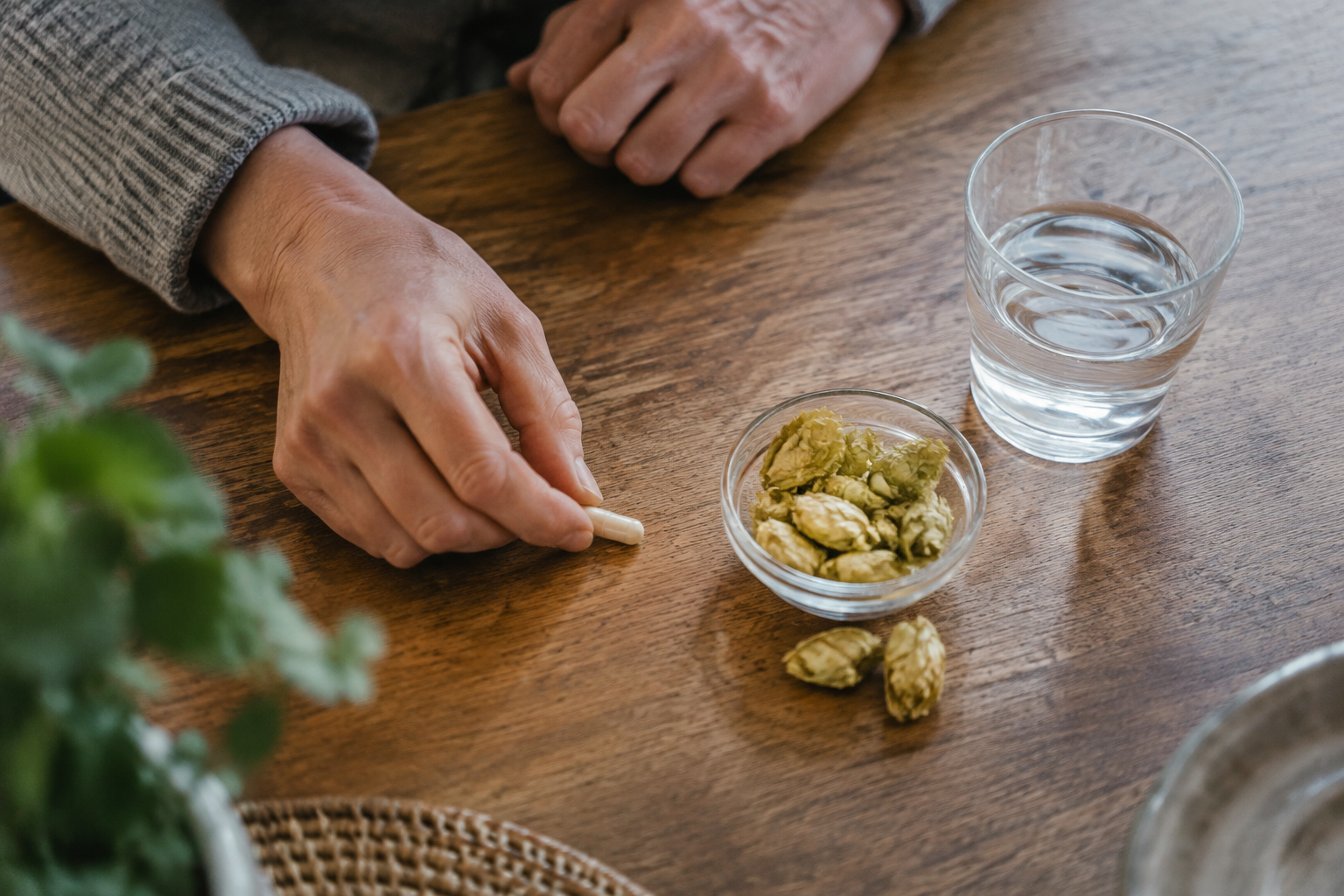
Calocurb takes a different approach. Its active ingredient, Amarasate, is an extract from a hops cultivar developed by New Zealand’s Bioeconomy Science Institute. It is delivered in a delayed-release capsule designed to carry the extract beyond the stomach to the small intestine.
Bitter taste receptors exist in the digestive tract as well as on the tongue. Activation of certain gut receptors can prompt the release of hormones involved in appetite regulation, including GLP-1, cholecystokinin, known as CCK, and peptide YY, or PYY.
The supplement is intended to stimulate that natural hormone release rather than act directly on GLP-1 receptors as semaglutide does. A shared connection with an appetite hormone does not establish that the two approaches produce equivalent effects on hunger or weight.
Kennedy said researchers examined more than a thousand extracts before selecting hops. The report does not give details of that screening programme or results demonstrating weight maintenance after prescription treatment ends.
Sarah Kennedy and Melissa Magsaysay discuss returning hunger
Kennedy described Calocurb as “a tool in the toolkit”, rather than a substitute for changing eating habits. Her account places the product within a broader approach to managing appetite, not as a replacement for dietary change.
She also drew on her own history, saying she began dieting at 11 and spent years struggling with her relationship with food. She framed hunger as a biological drive shaped by a world in which finding enough to eat was once uncertain, and said stress and poor sleep could make that drive harder to manage.
Podcast host Melissa Magsaysay recalled conversations with friends in their forties and fifties who had experienced relief from persistent thoughts about food after starting GLP-1 medicines. Some, she said, valued that change even when treatment brought side effects.
Those recollections illustrate why renewed hunger can be troubling, but they are personal accounts rather than evidence about Calocurb. Kennedy’s comments also come from the founder and chief executive of the company selling the supplement; the report does not include an independent clinical assessment of its use after GLP-1 treatment.
Evidence on Calocurb after GLP-1 treatment remains an open question
The account leaves several practical questions unanswered. It supplies no estimate of how much weight people might maintain with Calocurb after stopping a GLP-1 medicine, how long any benefit might last, or how outcomes would compare with support alone.
It also gives no timetable for a trial specifically testing the supplement in this setting. The proposed biological mechanism is therefore more clearly described than the outcome that matters to prospective users: whether it helps them keep weight off after treatment.
That question sits within a wider investigation of what support people need when medication ends. Our related coverage examines a GLP-1 trial suggesting support may limit weight regain after stopping.
For Calocurb, the evidence described in this report stops short of an answer. Returning hunger provides a reason to investigate an intervention; it does not, by itself, demonstrate that the intervention works.